
SEO monitoring has evolved far beyond running a technical audit once every few months. Modern websites change constantly: developers deploy updates, content teams publish new pages, plugins introduce conflicts, and server configurations shift unexpectedly. In that environment, relying solely on periodic audits means problems can remain undetected for weeks.
That’s why continuous SEO monitoring has become increasingly important in 2026. Search engines crawl websites frequently, and seemingly minor technical issues—broken links, accidental noindex directives, redirect loops, mixed content warnings, or downtime—can quickly affect organic performance if they go unnoticed.
The challenge is that not all SEO tools are built for ongoing monitoring. Some excel at deep, point-in-time audits, while others are designed to continuously scan your website and alert you when issues emerge.
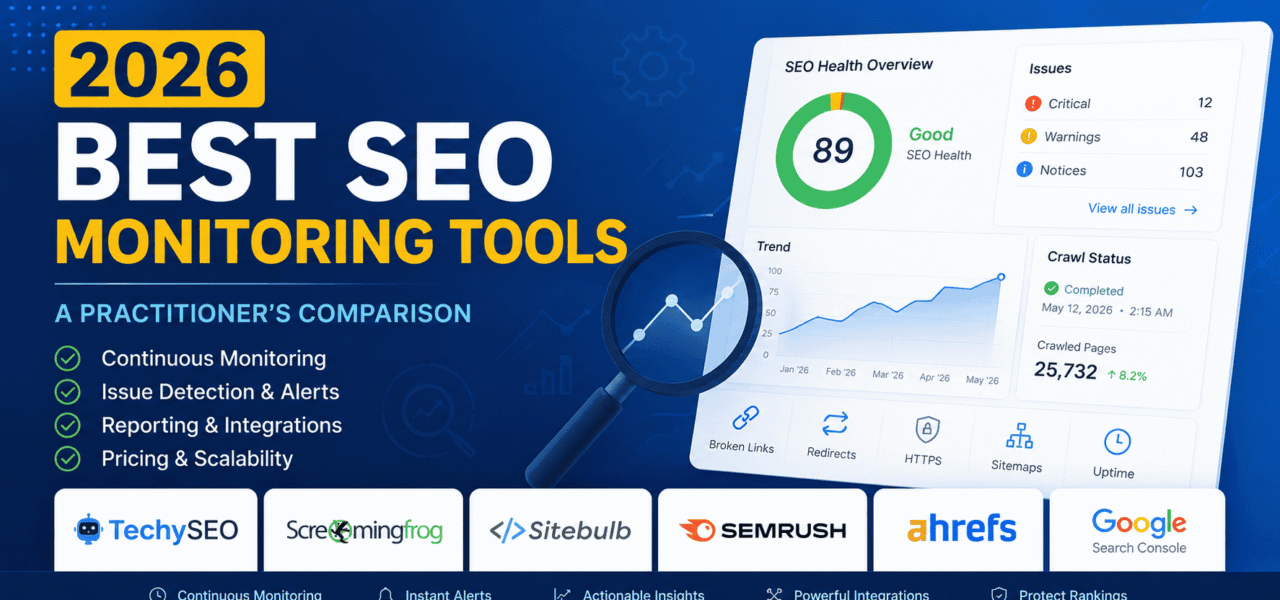
In this comparison, we’ll evaluate the best SEO monitoring tools in 2026 using practical criteria that matter to SEO teams and agencies:
- Crawl frequency
- Breadth of issue detection
- Alert capabilities
- Reporting quality
- Integrations
- Pricing structure
- Scalability
- Ease of implementation
The goal isn’t to crown a universal winner. It’s to help you choose the right platform based on how your team actually works.
What to Look for in an SEO Monitoring Tool
Before comparing platforms, it’s important to distinguish between an automated SEO audit tool and a true continuous SEO monitoring solution.
Audit tools provide snapshots. Monitoring tools provide ongoing visibility.
When evaluating SEO monitoring software, consider the following criteria:
| Criterion | Why It Matters |
|---|---|
| Crawl frequency | Determines how quickly new issues are detected |
| Issue coverage | Technical SEO, on-page issues, redirects, uptime, security, and more |
| Alert system | Fast notifications reduce time-to-fix |
| Reporting | Trend analysis and issue history improve prioritization |
| Integrations | Connect SEO health with business outcomes |
| Pricing model | Impacts scalability as sites grow |
| Scale | Supports large sites and multiple clients |
| Ease of use | Faster onboarding and team adoption |
Why Crawl Frequency Matters More Than Price
Many teams compare tools primarily by monthly cost. That’s understandable—but often shortsighted.
If a platform only audits monthly, a critical issue introduced on Day 2 could remain unresolved for nearly a month. By then, rankings, crawl efficiency, and user experience may already be affected.
For most teams, alert quality and monitoring frequency create more business value than small differences in subscription costs.
Tool 1 — TechySEO
Positioning
TechySEO is built specifically for continuous technical SEO monitoring. Unlike traditional audit tools that require manual initiation, it focuses on always-on visibility and proactive detection.
Core Strengths
Automated Continuous Crawling
Its standout capability is configurable, scheduled monitoring through continuous crawling. Teams can determine how frequently sites are checked based on their publishing velocity and risk tolerance.
Rather than waiting for quarterly audits, issues surface as they occur.
Broad SEO Coverage
TechySEO monitors:
- Broken internal and external links
- Redirect chains and loops
- HTTP status issues
- Title tag problems
- Meta description issues
- Missing or duplicate H1s
- HTTPS implementation problems
- Mixed content errors
- XML sitemap issues
- robots.txt conflicts
- Website availability
This breadth allows teams to consolidate multiple monitoring functions.
Issue Prioritization
One common complaint about SEO monitoring software is noise.
Many platforms overwhelm users with lengthy issue lists without context. TechySEO addresses this through an issue prioritization engine that attempts to rank problems by likely SEO impact rather than merely reporting their existence.
This helps teams focus resources on fixes that matter most.
Integrations That Add Context
Native integrations with Google Search Console and GA4 allow users to connect technical issues with actual performance indicators.
Instead of asking, “Is this problem important?” teams can evaluate whether affected pages also generate meaningful organic traffic.
Immediate Alerts
Fast detection only matters if people know about it.
TechySEO provides alerts when new issues appear, enabling faster remediation and reducing exposure.
Limitations
TechySEO intentionally focuses on monitoring rather than becoming an all-in-one SEO suite.
It is not designed to replace:
- Backlink analysis tools
- Rank trackers
- Content optimization platforms
- Competitive intelligence suites
Best For
- In-house SEO teams
- Agencies managing multiple websites
- Technical marketers wanting automated oversight
- Organizations shifting from reactive audits to proactive monitoring
Tool 2 — Screaming Frog SEO Spider
Positioning
Screaming Frog remains one of the industry’s most respected technical SEO tools.
It excels at comprehensive, point-in-time audits.
Core Strengths
Extremely Deep Technical Analysis
Few crawlers match its flexibility.
Capabilities include:
- Detailed crawl diagnostics
- JavaScript rendering
- Custom extraction
- XML sitemap generation
- Log file analysis
- Advanced filtering
For experienced technical SEOs, it’s extraordinarily powerful.
Industry Adoption
Its widespread use means:
- Extensive educational resources
- Established workflows
- Strong community knowledge
Most experienced practitioners already understand its interface.
Limitations
Despite its strengths, Screaming Frog isn’t built for continuous website monitoring SEO workflows.
Its limitations include:
- Desktop-based deployment
- Limited collaboration
- No native uptime monitoring
- No proactive alerting
- Manual execution requirements
- Free version capped at 500 URLs
Best For
- Technical specialists conducting deep audits
- Consultants investigating complex issues
- Teams comfortable with desktop workflows
Not Ideal For
Organizations seeking continuous monitoring and automated detection.
Tool 3 — Sitebulb
Positioning
Sitebulb combines powerful crawling with stronger usability and visual reporting.
It has become particularly popular among agencies.
Core Strengths
Excellent User Experience
Compared with some technical crawlers, Sitebulb’s interface feels more approachable.
Visual cues simplify diagnosis and reduce learning friction.
Outstanding Reporting
Sitebulb shines when presenting findings to clients.
Features include:
- Visual charts
- Prioritized recommendations
- Executive summaries
- Easy-to-share exports
Crawl Comparisons
Users can compare historical crawl data to identify changes between audits.
This is valuable when demonstrating progress.
Limitations
Although Sitebulb offers cloud capabilities, its core workflow remains audit-centric.
Limitations include:
- Less emphasis on continuous SEO monitoring
- No built-in uptime monitoring
- Higher costs for larger teams
- Limited alert functionality compared with dedicated monitoring platforms
Best For
- Agencies delivering client reports
- Teams prioritizing presentation quality
- SEO consultants needing visual storytelling
Tool 4 — Semrush Site Audit
Positioning
Semrush Site Audit exists within the broader Semrush ecosystem.
For existing subscribers, it provides convenient access to website health monitoring.
Core Strengths
Scheduled Crawls
Depending on subscription level, users can configure recurring audits.
This provides some level of automation.
Unified SEO Platform
Semrush users benefit from having:
- Rank tracking
- Keyword research
- Competitor analysis
- Backlink monitoring
- Site auditing
inside one interface.
Historical Reporting
Trend reporting helps teams evaluate whether site health improves over time.
Limitations
Semrush’s monitoring capabilities sometimes feel secondary to its broader platform objectives.
Potential drawbacks include:
- Crawl limits at lower tiers
- Reduced monitoring frequency on smaller plans
- Large volumes of low-priority recommendations
- No native uptime monitoring
Best For
- Organizations already invested in Semrush
- Teams wanting a consolidated SEO stack
- Marketers seeking convenience over specialization
Tool 5 — Ahrefs Site Audit
Positioning
Ahrefs Site Audit complements Ahrefs’ well-known backlink intelligence capabilities.
Core Strengths
Strong Technical Detection
The platform identifies many common technical and on-page issues, including:
- Broken pages
- Redirect problems
- Duplicate content signals
- Metadata concerns
- Internal linking opportunities
Integrated Backlink Context
Because Ahrefs excels in link intelligence, teams can combine technical insights with backlink data.
Limitations
Like Semrush, the audit component feels adjacent to the platform’s primary strengths.
Common concerns include:
- Frequency limitations on lower plans
- Less focus on proactive monitoring
- No uptime functionality
- Alerting that lacks the immediacy of dedicated monitoring software
Best For
- Existing Ahrefs subscribers
- SEO teams emphasizing backlink analysis
- Organizations seeking bundled functionality
Tool 6 — Google Search Console (Free)
Positioning
Google Search Console is indispensable.
However, it is often misunderstood.
Core Strengths
Direct Data From Google
No third-party tool has greater authority regarding how Google interacts with your website.
It provides insight into:
- Coverage issues
- Indexing status
- Manual actions
- Core Web Vitals
- Search performance
- URLs Google encountered as problematic
Completely Free
For organizations with limited budgets, GSC provides tremendous value.
Limitations
Google Search Console is not a complete SEO health monitoring solution.
Most importantly, it only reports what Google has discovered.
It does not proactively crawl your website the way dedicated monitoring platforms do.
That means:
- Internal broken links may remain invisible.
- Redirect issues can go unnoticed.
- On-page problems aren’t comprehensively audited.
- Downtime isn’t monitored.
- Proactive alerts are limited.
Best For
Every SEO team.
But it should complement—not replace—a dedicated monitoring platform.
Comparison Table
| Feature | TechySEO | Screaming Frog | Semrush Site Audit | Ahrefs Site Audit | GSC |
|---|---|---|---|---|---|
| Continuous monitoring | ✅ | ❌ | Partial | Partial | Partial |
| Uptime monitoring | ✅ | ❌ | ❌ | ❌ | ❌ |
| Broken links | ✅ | ✅ | ✅ | ✅ | ✅ (partial) |
| Redirect analysis | ✅ | ✅ | ✅ | ✅ | ❌ |
| On-page SEO | ✅ | ✅ | ✅ | ✅ | ❌ |
| Issue prioritization | ✅ | ❌ | Partial | Partial | ❌ |
| GSC integration | ✅ | Partial | ✅ | ✅ | — |
| GA4 integration | ✅ | ❌ | Partial | ❌ | ❌ |
| Alerts | ✅ | ❌ | ✅ | ✅ | Email only |
| Price | From free | From £149/year | From $119/month | From $99/month | Free |
Which Tool Is Right for You?
If You Want Continuous Monitoring and Alerts
Choose TechySEO.
It was designed around ongoing visibility rather than scheduled audits.
This makes it particularly well-suited to modern websites that change frequently.
If You Need the Most Powerful One-Time Audit
Choose Screaming Frog.
Its technical depth remains difficult to match.
If You Already Use Semrush for Everything
Choose Semrush Site Audit.
The convenience of keeping everything inside one ecosystem may outweigh specialization.
If Your Budget Is Zero
Use Google Search Console plus TechySEO’s free tier.
This combination provides both Google’s perspective and proactive detection.
For Agencies Managing Multiple Clients
TechySEO and Semrush Agency plans offer the strongest operational fit, depending on whether continuous monitoring or broader marketing functionality matters more.
The Ideal SEO Monitoring Stack in 2026
Rather than relying on a single platform, many mature SEO teams combine complementary tools.
A practical stack often includes:
- A dedicated monitoring platform for ongoing detection
- Google Search Console for Google’s view of the site
- PageSpeed Insights for performance diagnostics
- Deep audit tools for periodic investigations
This layered approach balances visibility, context, and depth.
Conclusion
The distinction between audits and monitoring has never been more important.
Traditional crawlers remain invaluable for investigations and detailed analysis. But modern SEO operations increasingly require proactive detection, automated alerts, and continuous oversight.
When evaluating the best SEO monitoring tools in 2026, focus less on price and more on how quickly issues surface and how effectively teams can act on them.
For organizations seeking true continuous monitoring, dedicated platforms offer advantages that audit-first tools struggle to replicate.
The right choice ultimately depends on your workflow, team structure, and tolerance for risk—but waiting weeks to discover critical SEO issues is rarely a winning strategy.
TechySEO was built specifically for continuous SEO monitoring — not as an add-on module to a rank tracker. See the difference: Start your free trial → https://app.techyseo.com
